Updated Nov 4, 2026 9:31 AM EST · By Emma Jackob
The best time to visit Japan is late March to mid April for cherry blossoms, or mid October to late November for autumn leaves and mild, dry days. Tokyo's blossoms open around 24 March on average, according to the Japan Meteorological Agency. The week to avoid is Golden Week, 29 April to 5 May 2027.
Spring and autumn win: Tokyo highs in the 60s and 70s Fahrenheit, the two big seasonal sights, and none of summer's heat or June's rain. Here's each month, on the Japan Meteorological Agency's 1991 to 2020 averages for Tokyo.
| Month | Average high in Tokyo | Rain in Tokyo | What's happening | Our verdict |
|---|---|---|---|---|
| January | 50 F (9.8 C) | 60 mm | New Year holiday ends 3 January; cool, dry days | Good after the first week |
| February | 52 F (10.9 C) | 57 mm | Driest stretch of the year, quiet | Good for city trips |
| March | 58 F (14.2 C) | 116 mm | Cherry blossoms open late in the month | Great from the last week |
| April | 67 F (19.4 C) | 134 mm | Full bloom early in the month; Golden Week starts 29 April | Best, until the 28th |
| May | 75 F (23.6 C) | 140 mm | Golden Week to 5 May, then calm | Great after 6 May |
| June | 79 F (26.1 C) | 168 mm | Rainy season from early June | Fair, pack an umbrella |
| July | 86 F (29.9 C) | 156 mm | Rainy season ends mid July, then heat | Fair |
| August | 88 F (31.3 C) | 155 mm | Hottest month; Obon 13 to 16 August; typhoon peak | Hardest month to go |
| September | 82 F (27.5 C) | 225 mm | Still hot, wettest month, typhoon peak | Fair |
| October | 72 F (22.0 C) | 235 mm | Cooler; Hokkaido's leaves turn late in the month | Great from mid month |
| November | 62 F (16.7 C) | 96 mm | Maples peak in Tokyo late in the month | Best |
| December | 54 F (12.0 C) | 58 mm | Kyoto leaves into early December; New Year rush from 29 December | Good before the 28th |
Averages, not forecasts: any single year can run early or late. Check the Japan Meteorological Agency website (jma.go.jp) for the current season before you book.
Our advice: if you can pick only one window, take mid October to late November. It's as mild as spring, much drier in November, and easier to book than blossom season.
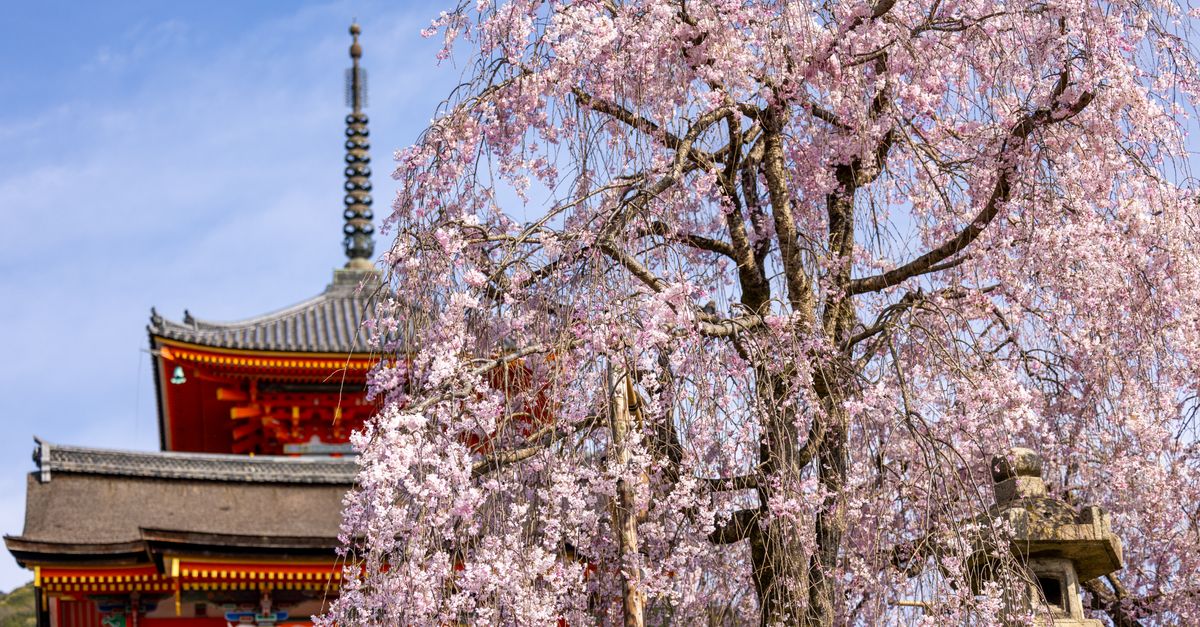
On Japan's main islands, cherry blossom season starts in March and reaches Hokkaido in May. In Tokyo, trees open around 24 March and reach full bloom around 31 March on average. Kyoto is a few days later, with full bloom around 4 April. Going by those averages, the first days of April are the safest bet for seeing Tokyo and Kyoto in bloom on one trip.
| City | First bloom, average | Full bloom, average | First bloom in 2026 |
|---|---|---|---|
| Tokyo | 24 March | 31 March | 19 March |
| Kyoto | 26 March | 4 April | 23 March |
| Osaka | 27 March | 4 April | 26 March |
| Hiroshima | 25 March | 3 April | 19 March |
| Sendai | 8 April | 13 April | 31 March |
| Sapporo | 1 May | 6 May | 18 April |
2026 ran early almost everywhere: Tokyo opened 5 days ahead of average and Sapporo 13 days ahead. The official 2027 forecast isn't out yet, so check JMA and Japan's weather services early in 2027.
We'd book Tokyo and Kyoto for roughly 25 March to 8 April. Running late? Sendai and Sapporo bloom weeks after Tokyo.
Japan's rainy season, tsuyu, runs from about 7 June to 19 July in the Tokyo region and from about 6 June to 19 July around Kyoto and Osaka, on JMA averages. Okinawa starts and finishes about a month earlier. In 2026 the Tokyo region's rains began on 2 June and ended on 19 July.
Tokyo's June rainfall averages 168 mm, which is less than September (225 mm) or October (235 mm). Cities, food and trains carry on as normal. If you hate humidity, though, skip June and early July.
Typhoons can reach Japan from May to November, but most come between July and October, peaking in August and September. JMA's 1991 to 2020 averages show 3.3 typhoons coming close to Japan in each of those two months, out of 11.7 a year, and about 3 a year making landfall. When one comes close, flights and trains can be delayed or cancelled.
If you travel then, we'd keep a free day at the end of the trip before your flight home. Check the JMA website and your airline's app in the days before you leave.
Maple leaves turn red around 28 November in Tokyo and around 5 December in Kyoto, by JMA's averages. Sapporo changes much earlier, around 28 October. That makes mid November to early December the sweet spot for Tokyo and Kyoto on one trip, and November rain in Tokyo averages only 96 mm.
Three holiday periods fill trains, flights and hotels nationwide. Work around them if you can.
Travelers on FlyerTalk have warned that the first and last days of Golden Week are the worst for trains and airports. That's their experience, but it matches what the holiday dates suggest.
Summer is the hardest season: Tokyo averages a high of 88 F (31.3 C) in August, it's humid, and typhoons peak. Summer festivals and fireworks are the reward, according to JNTO.
Winter is underrated. Tokyo's December to February averages run from 50 to 54 F (9.8 to 12.0 C) by day with under 60 mm of rain a month, the driest stretch of the year.
Fares follow demand, so the cherry blossom peak, Golden Week, Obon and New Year are the expensive weeks. KAYAK's own search data for 2024 and 2025 found January, February and September the cheapest months to fly from the US, and June and December the most expensive.
Tokyo has two airports, Haneda (HND) and Narita (NRT), so search both. Compare Delta, United and American with the Japanese airlines on the same dates, and check the final fare on the airline's website or app before you pay, because fares change daily.
US citizens don't need a visa for a tourist stay of up to 90 days, according to Japan's Ministry of Foreign Affairs. The US Embassy in Japan says your passport should be valid for the length of your stay. Entry rules change, so check the embassy and Japanese government websites a few weeks before you fly.
Related: How long it takes to get a passport
About this page
Written and fact-checked by the Flyingscanner team, last updated 4 November 2026. The facts in this post were checked on 4 November 2026. Airline fees and rules change, so confirm the details for your own trip with the airline before you pay. About Flyingscanner
Mark Flyingscanner as a preferred source and our travel guides are more likely to show up in your Google results.